Getting Started in Agility
By: Allison Bryant
So you want to get started in agility and don't know where to
begin. There are two options. First is finding an agility dog, the
other is training your current dog.
Finding an Agility Dog
Some people like to choose a puppy to begin agility. The main
benefit of a puppy is it is a clean slate from which to begin. The main
drawback is that at 8 weeks of age, it is difficult sometimes to really know
what you are getting yourself into. In addition, you can't just dive into
training right away.
There are aspects of agility training that can only be done
when the dog is mature and ready for it. You should not begin
jump training until the dog's growth plates have closed. There is a lot of
training you can do with a puppy, but with an older dog, you don't have to
wait if they are already done growing.
When choosing a puppy, be sure to examine the parents. They will
be a good indication of what kind of characteristics your puppy will
possess when it is grown. High drive parents typically produce high drive
offspring. Low drive parents usually produce low drive offspring.
Before you begin your puppy search, put careful thought into what you
would like in your puppy.
Do you want a high drive dog racing around the course? Most
people say YES!
However, if this is your first dog, you might want something a
little calmer, that you can keep up with. If this is your fourth dog, and you
have successfully trained three already, you might be ready for the
turbo charged dog. Make a list, be honest with what you want and try
to find it.
If you don't know what you are looking for, it's hard to find it!
What do you look for in a puppy? The two big traits are drive
and biddibility.
Drive is the intensity and focus the dog has while performing an
activity.
Biddibility is the amount of 'bend' a dog has when being
trained. I have a dog with a huge amount of drive. She is very fast. However,
she has very little biddibility. When I make a mistake on course, she barks
and jumps up at me. She is very unforgiving. I have another dog that has
high drive coupled with high biddibility. He is my main agility dog now.
When I make a mistake on course, he rolls his little doggie eyes at me and
keeps trying.
He is a saint, I know that and he is rewarded generously.
When you have a high drive dog, not only are they fast when doing
agility, but they are intensely focused on you. They don't usually get
distracted as easily by the cute yellow lab waiting next in line. In
addition, they are usually the same each day. You have the same amount of dog
on day one as on day four of a show. Lower drive dogs can get tired or be
hard to motivate. With lower drive dogs, you will have to be a creative
trainer to keep them interested. (This is not always a bad thing. Less than
perfect dogs can force you to be a better trainer, if you are really
committed.)
When you have a high drive dog, sometimes they are easier to
train. Ball or frisbee crazy dogs are nice to train because you don't have to
keep feeding them treats. Their motivation is the toy and the only limit to
that is how long you want to throw it for them. Don't underestimate the
drive of a food motivated dog though. They can accomplish great things. If you
have a dog that is not motivated by food, toys or play, then you will have
to be creative.
Biddibility is the amount of 'bend' in a dog. By bend, I mean
the amount of forgiveness a dog will show and molding he will take. You
have to be able to teach your dog. Your dog has to have enough patience
with you to settle down and learn the lesson at hand. An example of a high
drive dog with no biddibility would be a dog that is so focused on the ball
you are holding, it can't possibly think about anything else. You will
have to teach it that in order to get the ball, the dog must do something for
you first.
A biddible dog when taught the "trade off" system, will start to
think "Oh what can I do, what can I do?!" an unbiddible dog will think "I
don't care, give me that ball anyways!"
A biddible dog is forgiving when you make handler errors on
course. And believe me you will. This kind of dog will try to figure out
what you want and keep going. A biddible dog will have the mental stamina to
handle the stressful environment of the trial arena. However, one must be
careful with a biddible dog. If the mistake that was made on course was
caused by the handler, be sure not to blame the dog. Too much blaming of
the dog can turn an enthusiastic dog into a worried slow one. Mistakes
on the agility course are usually traced back to not enough training in
that area.
Training is the handler's responsibility, not the dog's.
So how do you determine if the puppy you are looking at is
biddible and has high drive? Look at the parents. They are a good indication.
What about puppy tests, you ask? Well, two of my dogs wouldn't roll on
their backs as puppies. Now they do it all the time.
Puppies change on a daily basis.
I feel that puppy tests are not the end all indicator of what you
will have in two years. Socialization and training can change a puppy in
many ways for good and bad.

Getting an older dog
If you are interested in getting an agility dog, but the prospect
of a puppy doesn't interest you, I recommend getting a rescue. People
sometimes shy away from a rescue because they think they are 'damaged'. But
they have benefits. The greatest benefit of a rescue, is what you see is
what you are getting. If the dog is high drive and biddible at two years
old, chances are they aren't going to change. At two years old, you can get
their hips x-rayed and have their eyes CERF'd. Now you know that your dog
is good to go. With a puppy, there is a little uncertainty until it
grows up.
There are a lot of aussies in rescue for the exact reasons that
make them excellent agility dogs. They needed a job, they needed exercise,
they were bored sitting on the couch, and the list goes on. These are the
high drive type of dogs that enjoy going out and running around. A lot of
rescues are starved for attention and welcome the training and the close
relationship that comes with it. A lot of rescues melt when praised for doing
a good job.
They can be very easy to motivate because they are a bit 'needy'.
For people who already have a dog and want to use it, the issues
of drive and biddibility are relevant too. If your dog is already high
drive and biddible, you are in great shape to begin training. If your dog
is little lower drive and not as biddable, there are things you can work on
before and during your agility training to increase your chances at a
successful agility career.
If you are starting agility with a non-puppy type dog, be sure
that the dog is physically suited for what you are asking. Before
starting jump training, for instance, make sure the dog is at an appropriate
weight for his height and build. If your dog is overweight, it will put a
lot of stress on his body. If your dog has been sitting on the couch
for the past two years, ease him into agility training slowly. Don't expect
him to be racing around the course right away. There is a lot of
conditioning that goes into being an agility dog. You don't want your dog
sidelined by injuries due to too much too soon. I will address conditioning
in another article.
Conformation of the agility dog
How an agility dog is put together seems to vary widely.
However, there are some traits that appear frequently in successful dogs. The
most important trait is moderation. You want a dog that is big enough
to do his job but no more. You want the dog to have all the
characteristics to perform his best, but none of the added duty of carrying
around anything else. A dog's bone structure should be substantial enough to
take the running, jumping and turning that is required in agility.
However, you don't want any more bone than that. More bone is just more
weight to carry around. Coat is pretty, however, too much coat is just more
weight and heat. A hot agility dog is usually slower. (This goes for
excess fat on the dog too.) A dog's height should be tall enough to be
competitive with the fast aussies, but not so big that the dog has trouble fitting
between the weave poles or has trouble collecting and as a result strides
over the contacts. A smaller aussie will usually double step in the weave
poles. This takes extra time. A large Aussie will have trouble
squeezing between the weave poles. The just right sized aussie will be able to
single step as they slalom through the poles like a snake. I feel that dogs
that fit the breed standard as "a well-balanced dog of medium size and
bone" will be competitive agility.
Article supplied by:
Allison Bryant
http://www.fourmileaussies.com
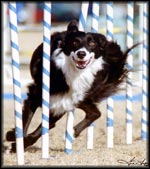
The picture in the middle of the page is Duncan, a Border Collie Rescue
who now competes in both USDAA and NADAC agility. Please visit
Duncan's home page where you can see more pictures and read more about agility
http://www.gooddog.org/pics.html
See Also:
All Canine Care & Doggie Fun Stuff
Search Our Site for Dog & Pet Information
How to Keep Your Dog & Cat Healthy