Canine Frisbee
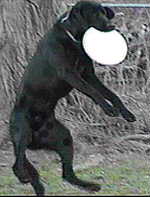
Frisbee Dog Championship of the World
By: Tippy
In the dog Frisbee disc world there is a competition known
as the Frisbee Dog World Championship also known as the
Canine Frisbee Disc World Championship. And, the Ashley
Whippet Invitational World Championship held annually.
The Frisbee Dog World Championships started in 1975 when Irv
Lander, Eldon McIntire and Alex Stein organized the first
World Championship for flying-disc (otherwise known as
Frisbee) catching dogs and the dog's handlers. Since then
the world championships have continued annually. Alex Steins
dog Ashley Whippet won the world championships the first
three years the competition was held in 1975, 1976 and 1977.
Eldon McIntire owned a "disc dog" by the name of Hyper Hank.
Irv Lander worked for the maker of Frisbee, a company by the
name of Wham-O. He promoted another event for humans by the
name of Junior Frisbee Disc Championships. In the beginning
the human event and the dog event took place alongside each
other at the Rose Bowl in Pasadena, California in the United
States of America.
After a while the competition turned into a contest series
and in the early 1980's the completion was renamed to the
Ashley Whippet Invitational or AWI. The contest series
included regional and local events for the "disc dog's and
their handlers would qualify for the AWI World Finals
Championship. In the middle of the 1990's the AWI World
Finals was the only championship event and there was only
one organization for "disc dog" competitions.
In order to qualify to be a part of the AWI World Finals
Championship which was a winner-take-all twenty-four hour
event you had to be a part of the first or second winning
teams in four to six regional contests.
The regional system was open only to competitors that lived
within that region to be a part of the regional qualifier
competition. Eight to sixteen teams can qualify depending
upon the number and format of the regional qualifiers that
are held within that year.
The format for the early tournaments was "Throw and Fetch"
contests. Judging can be based on distance, style points,
throwing into a circle or standing in a circle and throwing
out.
Peter Bloeme won the Men's World Frisbee Championship in
1976 and then won in 1984 a Frisbee Dog World Championship.
He then retired from the sport and started working for AWI
as an event coordinator and a judge. Peter Bloeme is
credited with pushing the sport to become what it is mostly
today, a multiple disc freestyle contest. The World Finals
Championship was changed over time to include freestyle
events, also known as "Freeflight," and an event which is
timed called "MiniDistance" or "Distance/Accuracy" which is
a throw and catch event.
Frisbee Dog World Championships part 2
Peter Bloeme, Jeff Perry, Alex Stein and Eldon McIntire
introduced a trophy cup known as the Lander Cup that would
commemorate the yearly AWI World Champions.
This large silver cup is mounted on a wooden base which is
covered with small plaques inscribed with the names of the
winners of the competition each year. The Lander cup is
dedicated to Irv Lander in his memory the then executive
director of the AWI tournament series.
When Lander died in 1998 he left the AWI tournament series
and the business related to the AWI to his son Steve Lander.
Many people within the business and the competition expected
Peter Bloeme to succeed Irv Lander when he died.
It was within that year that the AWI series was first filmed
on TV. The event was sponsored by a popular dog brand food
known as ALPO. The event was shown on the Animal Planet as
the ALPO Canine Frisbee Disc World Championship.
The "on screen" announcer for the event was Peter Bloeme.
After the 1998 AWI World Finals Championship Peter Bloeme
left the AWI and did not renew his contract with them.
Peter Bloeme then went to Friskies Pet Care Company and was
hired as a consultant in 1998. He then started Skyhoundz, a
disc dog company, with Jeff Perry. He couldn't start
competing with AWI for one year after splitting with the
company but after that year was up he started his own
competitions with Skyhoundz.
In the year 2000 Skyhoundz organized the Canine Frisbee Disc
Series for Friskies. This included the ALPO Canine Frisbee
Disc World Championship. This even was televised on Animal
Planet and took place in New York Central Park in a small
sized field.
This event was not an AWI event but the champions of the
event where awarded the Lander Cup. This is the only time
that winners in the disc dog world were ever awarded the
Lander Cup outside of an AWI event. After 2000 ALPO no
longer sponsored the event.
Frisbee Dog World Championships part 3
In 2001 the Skyhoundz continued their series and
competitions without a big sponsor. The Skyhoundz then
introduced a special Frisbee for dogs known as the
Hyperflite disc and intended for use within the
competitions.
Skyhoundz after 2000 had their own trophy made and it is
engraved with all of the past winners of the AWI
Championships as well as all current winners of the
Skyhoundz World Championships. AWI objects to Skyhoundz
claiming the previous winners of AWI as a part of their
champions.
In the year 2000 AWI quit for two years and then reorganized
and started running competitions again in 2003. This is
without the support of series. The events were all welcome
meets. The first one in 2003 was held in Japan and the event
continued to run through 2005.
In 2006 AWI became a part of UFO also known as Unified
Frisbee Dog Operations World Cup Series. UFO runs the Ashley
Whippet Invitational World Championship as the final event
of the season.
Competitors who qualified for the UFO finals and the AWI
World Championship earn points in the UFO World Cup Series
or by finishing within the top 15 at the semi-final event.
One event that is a qualifying event held by UFO is the Irv
Lander Memorial Canine Frisbee Championships which is named
in honor of Irv Lander since the year of 2003.
Skyhoundz continues to compete with UFO and both companies
are well respected within the Disc Dog community. Skyhoundz
is not as popular as the UFO competition series. There is
still a debate going on as to whether Skyhoundz can legally
claim the AWI winners on the Skyhoundz trophy.
In 2006, UFO held its first World Cup Final, in Scottsdale,
Arizona. The competitors came from around the world for this
event.
Your Dog can be totally
Healthy
