Birds     |     Dogs     |     Cats     |     Horses     |     Small & Exotic Pets       


Free Information

About Agility

Tricks For Dogs


Tips and Tricks For Agility


An Introduction to  Agility
By: Dog Scouts of America


Agility is a fun sport for dogs and people. Performing the tasks
of climbing, jumping, and crawling over under around and through
various obstacles builds confidence in your dog in addition to
giving him a better sense of balance, teaching him to be aware of
where his body is, and keeping him physically fit. Dog agility
can be done for fun, fitness, recreation, exhibition or
competition. I have used agility training as a behavior
modification tool on a sharp-shy dog. It helps create confidence
and eliminate shyness and fear of the unusual. I have performed
dog agility as a crowd-pleasing event for my own personal
enjoyment (and other “perks” the performers receive) in front of
packed stadiums at exhibition centers. Recently, dog agility has
become a title event through several dog registries, such as the
U.K.C., A.K.C., NADAC, and USDAA. I have enjoyed competing in
agility with each one of my dogs in agility trials.


What ever your reason for wanting to learn agility, we want you
to learn it correctly and safely, and we want you and your dog to
have FUN! Because we want this to be fun for your dog, we will be
using positive reinforcement to motivate the dogs. Bring treats
to class with you. We will use a lot of them. Also, if your dog
is a “ball nut,” you can bring his ball or other favorite toy to
use as a target for some of the exercises. I recommend that you
keep your treats in a small plastic butter dish or similar reseal
able container. It not only keeps the treats fresh (and keeps the
dog from getting into them without permission), but the dish
itself will be used as a “target” for your dog on certain
obstacles and “go-outs.” You may train your dog on a flat buckle
collar, or a premier collar. Choke chains are not a good choice.
We don’t give any leash corrections in agility training, and if
the dog wears a collar at all, it should be one you can grasp
(without a lot of extra slack) to steady the dog. Leashes and tag
lines are permitted, but the best way to avoid injury to your dog
and keep him within an arm’s reach where you can safely steady or
“catch” him, is by wrapping your whole palm right around the
buckle collar.


We will introduce three new obstacles each week. There is a
reason for the particular sequence of learning them. Please do
not attempt to negotiate any obstacle with your dog which you
have not properly learned and have had help with going over the
first few times with your dog. As the dog learns each new
obstacle, and will enter it without hesitation, you will “name’
the obstacle. It is important that you don’t give the obstacle a
name until the dog is negotiating it correctly. Imagine if your
dog were petrified of the tunnel, but you stood next to it,
chanting, “Tunnel!, TUNNEL!” all the while your dog was squirming
to get away from it. What is it that your dog is going to
associate with the word, “tunnel?” He will be thinking about
hesitating or getting away from that thing. If you wait to use
the word until your dog is flowing easily through the tunnel,
then that is what he will associate with the word, and when you
ask him to “tunnel,” he will dash through it confidently, without
question. Wait until you have the behavior, before you name it!


Once the dog understands the meaning of a new obstacle’s name,
you may begin sending the dog away to the obstacle. Start with
just a few feet and move backwards until you can stand 30 feet
back and send the dog to the obstacle. Work the dog from both
sides. Do not make a habit of only working the dog in the “heel
position” side. Train also with the dog on the right. Approach
the obstacle at an angle from the right and from the left,
signaling and commanding the dog to take the obstacle. Work out
on both sides until you can stand out to the side 30 feet and
send your dog to the obstacle. Word recognition and obstacle
discrimination is teaching the dog to differentiate between two
obstacles, based on their names. To teach this, start with one
obstacle which your dog knows the name of, and place the new
obstacle nearby. Command the dog from a short distance to take
the familiar obstacle. Then, give the less familiar obstacle’s
command word, and see if the dog listens, or tries to go for the
more familiar obstacle. There is no correction for a wrong
answer, except that you do not praise the dog, and you help the
dog to go through the obstacle you indicated, followed by praise.
When you praise, be sure to let the dog know what it was that he
did “good.” Say, “Good Tunnel!” to let the do know he was correct
for choosing the tunnel.

Week One

Pipe Tunnel

A-Frame

Clear Jump

Combining Obstacles


Pipe Tunnel Introduction:

Show your dog the tunnel. Let him sniff it. Toss his object of
attraction into the tunnel a short distance to see if you can
make him curious enough to venture in. Getting the dog to enter
the tunnel the first time can be like trying to convince him to
walk through fire! But, after as few as one successful attempt at
going through the tunnel, the dogs are convinced that this is a
really cool thing to do. After a few repetitions, you cant keep
them out of the tunnel! Be patient. If you have to, crawl through
the other end of the tunnel to coax the dog in to you, then give
him a treat. Sometimes it is helpful to “scrunch” up the tunnel
and make it shorter, so that it doesn’t look so spooky. By making
the tunnel only a few feet long, some dogs will be a little more
brave about going in. However, other dogs become even more
frightened by the movement of the tunnel (while you are trying to
hold it in a scrunched position) or the extra material which gets
wadded up when you scrunch it (it makes the opening look even
smaller). Do not try to push or drag your dog through the tunnel.
This will only make him more fearful of entering the dreaded
“dog-eating snake.” Take your time, and work slowly. When your
dog will easily enter and exit the tunnel, and you have added the
command (“tunnel”), you can start working from further back, and
from both sides, until the dog will approach the obstacle from
any direction and take it as prescribed. Do not proceed to learn
the other tunnels until your dog has mastered the pipe tunnel.


A-Frame Introduction:

Start with the A-Frame lowered to a very negotiable height. If
flat on the ground is necessary, then flatten that sucker out!
However, most dogs are unafraid enough to try it for the first
time with a slight incline. The instructor will help you judge
what is the best height for your dog. Walk the dog up and over
the A-Frame. Place your treats on the “contact zones” (the yellow
areas on the up and down sides of all ramp obstacles). Use a word
to help your dog understand that he should look down for some
food, which has been left there for him.


You can use any word for this. Some choices are: there, spot,
treat, look, place, touch or whatever you think works best. The
dog should always get his treat on these zones--never on the
ground beyond the zones, never from your hand after he is already
off the obstacle. In addition, if your dog accidentally by-passes
the zones, do not let him return to the obstacle to get it. That
teaches him that he does not have to stop, as he is free to go
back. It also teaches him to steal food from the contact zones
without being commanded over the obstacle, and it also encourages
him to run up on obstacles over which he was not asked to climb.
If your dog misses the food, just go on. “There” As the height
of the A-Frame is raised to become more of a challenge to your
dog, he should still willingly try to traverse it, as he has done
so at a less steep angle. Do not let the dog jump off the sides
of this obstacle at any time, high or low. Place your hand around
the buckle collar to steady the dog. As the A-Frame reaches full
height, use a spotter (a person walking on the opposite side from
you to keep the dog from falling or jumping off). If the dog
balks on the A-Frame at it’s full height, it will usually be on
the down ramp. Down is scarier than up. That is why dogs tend to
want to exit the obstacle right when they get to the top (the
most dangerous point).


To help your dog overcome his apprehension, pick him up and place
him on the down-side contact zone for his treat, then walk him
off. Gradually place the dog further and further back up on the
obstacle and have him walk down to get the treat, then walk off.
Work your way to the top and over (in reverse) until the
down-ramp will be a piece of cake to the dog. Any dog who shows
fear at any time in the learning of this obstacle can be
“backward chained” in this manner by starting him at the end of
the obstacle and having him work his way to the beginning. When
the dog begins taking this obstacle with ease, name the obstacle.
Some suggestions are: walk-up, climb, frame, scramble, wall, or
anything else you wish to name it. When your dog will easily
enter and exit the A-Frame, and you have added the command word,
you can start working from further back, and from both sides,
until the dog will approach the obstacle from any direction and
take it as prescribed.


Clear Jump Introduction:

Introduce the clear jumps by walking the dog on leash over the
jump at its lowest height. Jump over the jump with the dog. As
the dog willingly jumps the obstacle, use the praise word, “good
jump”. Next, start walking beside the jump, as you lead the dog
over the obstacle. Name the jump as the dog shows you he will
readily go over it as directed. You may also use your target, or
throw a treat or toy over the jump and have the dog jump after
it. Most dogs enjoy jumping, so they learn this one rather fast.
After the dog learns the basic, solid jump, he may progress to
other jumps in the weeks to come. Not all the clear jumps are the
same, and you may want to name them differently. For example, you
may want to use the word, “jump” to name the solid jumps, the
word, “bar” to name bar jumps, the word, “over” to name long
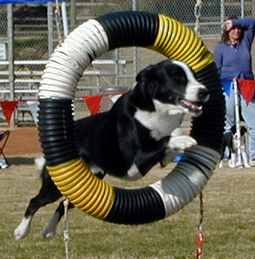
jumps, and the word, “tire” to name the hoop jump. When your dog
will easily jump for you, and you have added the command word,
you can start working from further back, and from both sides,
until the dog will approach the obstacle from any direction and
take it as prescribed.


Combining Obstacles:

As your dog learns each jump, he can put them together as part of
a course. To help your dog learn a sequence of jumps, use your
backward chaining steps. Start at the last one, add the middle
(then the last), and then do the first (then middle and last).
Practice the three jumps you learned during this session by doing
them first individually, then combine them as a series, to teach
the dog the idea of going from one obstacle to the next. Put his
favorite obstacle last, and place the target at the end.


Week Two

Closed Tunnel

Dog Walk

Pause Table

Combining Obstacles


Closed Tunnel Introduction:

When you first introduce your dog to the closed or “chute”
tunnel, scrunch up all or most of the material which makes up the
collapsible part of the tunnel. Have a helper hold the dog in
front of the tunnel and have “mom” or “dad” go down to the chute
end and gather up all of the folds of material. This makes the
tunnel appear much like the one he has already learned. The dog
should readily go through to mom or dad, who is waiting with
praise and a treat. Little by little, you may back up, so that
the chute part becomes longer and longer. When the dog is doing
the full length of the chute with someone holding it open, begin
dropping the material on the dog as he is about 3/4 of the way
through the chute. Start dropping the material sooner and sooner,
as the dog gets accustomed to pushing his way out of the chute.
Encourage the dog with auditory aids, like clapping and praise,
to keep him coming toward the end of the chute. Always make sure
the chute is straight and flat when you send your dog through the
tunnel. If your dog were to get tangled in the material, he would
twist around even more, and by the time he could be rescued, he
would have developed quite a panic about this tunnel. When the
dog is going through the tunnel with no problem, name the tunnel.
You can name it “tunnel” just like the other one, if you’d like.


Dog Walk Introduction:

Do not attempt this obstacle until the dog understands the
A-Frame at an equally steep angle. This obstacle is similar, but
it is much narrower, so your dog will have to be more careful in
negotiating it. Keep your treats (lure) down low to the plank, so
that the dog does not take his eyes off the walking surface. Use
a spotter to cover the far side of the obstacle, in case your dog
decides to exit prematurely. Place one hand around the collar,
and the other in front of the dog’s nose, with the treats held
down low. Watch what you are doing with that hand holding the
treats! Your dog’s nose will be “attached” to your fingertips,
and if you move your hand out away from the plank to look at your
watch, or something, the dog might try to walk off into thin air
to follow the treat! Bait your contact zones and slowly take your
dog over the obstacle. If the dog is reluctant to enter the ramp,
follow the instructions in the A-Frame section for backward
chaining: To help your dog overcome his apprehension, pick him up
and place him on the down-side contact zone for his treat, then
walk him off. Gradually place the dog further and further back up
on the obstacle and have him walk down to get the treat, then
walk off. Work your way to the top and over (in reverse) until
the down-ramp will be a piece of cake to the dog. Any dog who
shows fear at any time in the learning of this obstacle can be
“backward chained” in this manner by starting him at the end of
the obstacle and having him work his way to the beginning.


“Easy”

If your dog wants to race across this obstacle, place treats
across the long board to slow him down. A command, like “easy”
can also be employed. If your dog doesn’t know what “easy” means,
do not shout it at him while he is racing across the plank! Teach
him “easy” by working him separately (on leash), and making him
slow down in some other walking situation. Only then should you
use the word to try to slow him down on the dog walk. When the
dog begins taking this obstacle with ease, name the obstacle.
Some suggestions are: walk-up, climb, dog-walk, or anything else
you wish to name it. When your dog will easily enter and exit the
dog walk, and you have added the command word, you can start
working from further back, and from both sides, until the dog
will approach the obstacle from any direction and take it as
prescribed.


Pause Table Introduction:

Start at the lowest table height (it won’t be much of a table).
Place your target on the table surface toward the back (to give
the dog room to get up onto the table). Show the dog his treat
and send him for it. When he gets up onto the table, tell him to
lie down. As the dog shows willingness to hop onto the table,
begin using the command word, “table.” Give the dog a second
treat for lying down on command. As he gets the idea, you can
phase out the first treat, and give him only the second treat,
after he lies down. Practice also getting your dog to sit when he
gets on the table. He needs to sit or lie down immediately, so he
needs to develop a fast response to the command, and needs to be
able to sit from a down and down from a sit. If your dog does not
do a fast drop on command, you will need to teach him one. Use
the food in your left hand. Hold it in front of his nose. Quickly
drop the food to the ground as you say, “lie down.”
Simultaneously give an upward signal with your right hand. The
dog must drop quickly to get the food. Release the dog after he
drops. Practice this away from the pause table before you ask him
to do it on the table. Your dog will eventually have to maintain
his position (in either a sit or a down) for a count of five, so
he will also have to learn a stay command. If the dog gets up
before the count is over, reposition him. Do not shout, say, “NO”
or anything else. Reposition and say, “Good Stay.” Add
distractions to your stay exercise, by leaving the dog and
running away, or jumping up and down, or going behind him.
Reposition the dog if he falls for any of your proofing tricks.
Don’t let him get up from the stay until you give him a release
word (“Okay”). When your dog will easily jump onto the pause
table, and you have added the command word, you can start working
from further back, and from both sides, until the dog will
approach the obstacle from any direction and take it as
prescribed.


Combining Obstacles:

Practice the three jumps you learned during this session by doing
them first individually, then combine them as a series, to teach
the dog the idea of going from one obstacle to the next. Add the
obstacles you learned last week to his “mini-course.” Put his
favorite obstacle last, and place the target at the end.


Week Three

Hoop Tunnel

See-Saw

Bar Jump


Hoop Tunnel Introduction:

This tunnel is very similar to the other two your dog has
learned. However with the hoop tunnel, it is easy for the dog to
exit out the sides. You will want to work with a target, or with
two people to introduce this obstacle. It is important that you
line the dog up straight, and get him to go quickly through to
his target on the opposite end without being distracted. Other
than that, the training is just the same as it would be for the
other tunnels. If the dog knows the other tunnels, and you can
get him going straight in with speed, you should have no problem
with this tunnel. When your dog will easily enter and exit the
tunnel, and you have added the command (“tunnel”), you can start
working from further back, and from both sides, until the dog
will approach the obstacle from any direction and take it as
prescribed.


See-Saw Introduction:

It is imperative that your dog understand the A-Frame and the Dog
Walk before attempting this obstacle. At no time during the
introduction of this obstacle are you to work without a spotter.
Wrap your hand around the dog’s buckle collar and leave it there,
while the other hand coaxes him up the board with the treats held
low. The hard part will not be getting him to walk up, but it
will be getting him to stop at the desired point. Do not remove
your hand from the dog’s collar. As your dog’s front feet pass
the half-way point of the teeter-totter, you will have to
restrain him before he gets to the equilibrium point. Do not grab
the board and give him a false sense of security about the board!
Let him take one more step, and then let him stretch his neck and
body forward to reach for the treat. If he is on the precise
point, that change in balance will cause the board to start to
teeter. Hold the dog, not the board! Control the dog’s body so
that the board ever so slowly drifts down to the ground and
lightly touches. Be careful. Some dogs will feel the board teeter
and immediately want to back away. This will cause the board to
slam back down the way it was before it started to teeter. This
is extremely scary for the dog. After the board teeters all the
way down and is stationary, let your dog proceed down the plank.
Bait the contact zone as he gets to it. Walk him off the board.
Before your dog progresses to being able to negotiate this
obstacle without you hanging on to his collar, he must understand
the word, “wait.” Wait means to stop and hold still. Practice
stopping the dog in another situation and use the word, “wait.”
When you want the dog to take a step again, you tell him to walk.
To the dog, this see-saw looks just like the entrance ramp to the
dog walk, which he would normally just run right up. Make sure
your dog will respond readily to “wait” before you trust him to
do it on the see-saw. Try it with your hand out of the collar,
but with a leash on the first few times, until he has shown you
that he will safely make it through the teeter portion of the
obstacle. When your dog will easily enter and exit the see-saw,
you have added the command word, and your dog will wait, you can
start working from further back, and from both sides, until the
dog will approach the obstacle from any direction and take it as
prescribed.


Bar Jump Introduction:

The bar jump is much the same as the solid jump, but only
slightly more tricky. Depending on the location and orientation
of the bars (they could be single, double, triple, or
criss-crossed), they may seem to be floating in space, or scary
to the dog. Follow the same training instruction as for the basic
jump. You may want to name this jump something different, like
“bar.” When your dog will easily take the bar jump for you, and
you have added the command word, you can start working from
further back, and from both sides, until the dog will approach
the obstacle from any direction and take it as prescribed.


Week Four

Brush Jump

Rail Jump


Brush Jump Introduction:

The brush jump is like any other clear jump, but it is slightly
more scary, because dogs do not like to jump shrubbery. Do not
assume that the dog should easily jump this one because he knows
a basic jump, and you will save yourself much disappointment.
Follow the same training instruction as for the basic jump. You
may want to name this jump something different, like “brush.”
When your dog will easily take the brush jump for you, and you
have added the command word, you can start working from further
back, and from both sides, until the dog will approach the
obstacle from any direction and take it as prescribed.


Rail Jump Introduction:

The rail jump is like the bar jump, but it has non-displaceable
bars, so if your dog knocks into the jump, the bars will not fall
down. Follow the same training instruction as for the basic jump.
You may want to also name this jump “bar,” or “rail.” When your
dog will easily take the bar jump for you, and you have added the
command word, you can start working from further back, and from
both sides, until the dog will approach the obstacle from any
direction and take it as prescribed.


Week Five

Log Jump

Long Jump

Picket Fence Jump


Log Jump Introduction:

The Log jump looks a lot like the regular solid jump from the
dog’s point of view, and is a lot like jumping the regular solid
jump. The only difference is that the logs are arranged in a
pyramid formation, so that the jump is as long (at the base) as
it is high. The most common problem occurring with this jump is
that the dog cuts the corners. By using gates, or some form of
uprights at the sides of the jump, it will make it more of a
target for the dog. Follow the same training instruction as for
the basic jump. You may want to name this jump “jump,” “hup” or
“logs.” When your dog will easily take the log jump for you, and
you have added the command word, you can start working from
further back, and from both sides, until the dog will approach
the obstacle from any direction and take it as prescribed.


Long Jump Introduction:

The long jump is like a broad jump in obedience. It is made up of
a series of boards or pipes which span the ground in a horizontal
jump. When you begin teaching the long jump, use only two of the
sections, placed closely together. Then, depending on the size of
the dog and his eventual jump height category, spread the
sections further apart and/or add additional sections. This jump
has the same problem with dogs wanting to cut corners. By placing
uprights or flagpoles at the four corners of the jump, it will
clearly define the jumping surface for the dog. Another problem
with this jump is that if you move ahead too quickly, the dog
does not understand the horizontal jumping concept, and he tends
to think this is a “contact obstacle” rather than a “clear jump”
and will walk over the boards. You may want to use the command,
“over” for this one. When your dog will easily take the long jump
for you, and you have added the command word, you can start
working from further back, and from both sides, until the dog
will approach the obstacle from any direction and take it as
prescribed.


Picket Fence Introduction:

The Picket Fence Jump is similar to the regular solid jump.
Follow the same training instruction as for the basic jump. When
your dog will easily take the picket fence jump for you, and you
have added the command word, you can start working from further
back, and from both sides, until the dog will approach the
obstacle from any direction and take it as prescribed.


Week Six

This week we will run a fun course comprised of all of the
obstacles we have learned in agility one.

www.DogScouts.com
Copyright © Dog Scouts of America
5068 Nestel Road
St. Helen, MI 48656
(989) 389-2000

For more pictures of dogs and agility please go to this web site:
http://agilitytrials2000.homestead.com/trialslinks.html

See Also:

All Canine Care & Doggie Fun Stuff

Search Our Site for Dog & Pet Information

How to Keep Your Dog & Cat Healthy


Really Neat Gifts & Gift Ideas for Dog & Pet Lovers

Unique Dog Breed Specific Gift Items

     Adorable Stuffed Dogs & Stuffed Animals

     Quality Dog & Pet Supplies

     Dog Calendars, Posters, Shirts & Jewelry


"Mellow Out" Natural, Dog Stress Relaxer

Natural Dog & Cat Food & Treats


Free ==> Tippy & Alfred's Fun Pet Newsletter

Site Map

Disclaimer


Page Design by: Tippy & Alfred
Copyright ©
Choose To Prosper