Birds     |     Dogs     |     Cats     |     Horses     |     Small & Exotic Pets       


Free Information

About Service Dogs


What Is A Service Dog?
From: The Delta Society


What Is a Service Dog?

According to the Americans with Disabilities Act (ADA, 1990), a
dog is considered a "service dog" if it has been "individually
trained to do work or perform tasks for the benefit of a person
with a disability."

Also according to the ADA, a "disability" is a "mental or
physical condition which substantially limits a major life
activity" such as:

caring for one's self.
performing manual tasks.
walking.
seeing.
hearing.
speaking.
breathing.
learning.
working.


Some disabilities may not be visible, such as:

deafness.
epilepsy.
psychiatric conditions.


To be considered a service dog, the dog must be trained to
perform tasks directly related to the person's disability.


Example
Chris has a hearing disability and can't hear sounds such as a
smoke alarms, doorbells, sirens, or her name being called. Chris
is otherwise able to function with no other assistance. Chris has
a dog named Dusty.

If Dusty is trained to let Chris know when a sound occurs (e.g.,
smoke alarm, doorbell), Dusty is considered a service dog.

On the other hand, if Dusty is only trained to retrieve items
around the house and does not know how to alert Chris to sounds,
Dusty is not considered a service dog for Chris, because the task
of retrieving is not directly related to Chris' disability.


Other Terms Used to Refer to Service Dogs


To be consistent with the legal definition in the ADA, Delta
Society uses the following terms:

Service animal describes any animal that is individually trained
to do work or perform tasks for the benefit of a person with a
disability.

Service dog, adapted from the term service animal, is a
species-specific term to generically describe any dog in the role
of service animal.

Because people are more familiar with dogs as service animals,
this web site uses "service dog" instead of "service animal" to
make it easier for people to find the information they're looking
for. Most of the time, the information that refers to "service
dogs" also applies to service animals.

While the term "service animal" is legally defined, some
organizations use the term "assistance animal" or "assistance
dog."

The terminology used to label specific types of work dogs perform
for people with disabilities has not been standardized. For
example, a dog trained to help a person walk might be referred to
by different sources as a "mobility dog", a "walker dog", or a
"support dog." In addition to the wide variety of terms used,
many service dogs are cross-trained to perform more than one
category of work (such as guide and mobility for a person who is
blind and has severe arthritis) and labeling them by the work
they do becomes cumbersome.

Many individuals choose to identify their service animal
generically (as "service animals", "service dogs", "service
cats," etc.) because it identifies the roles of the animals
without disclosing the nature of the persons' disabilities, and
it is consistent with the terminology of the laws that protect
them.


The Difference between Service Animals, Therapy Animals,
Companion Animals and "Social/therapy" Animals


Service animals are legally defined (Americans With Disabilities
Act, 1990) and are trained to meet the disability-related needs
of their handlers who have disabilities. Federal laws protect the
rights of individuals with disabilities to be accompanied by
their service animals in public places. Service animals are not
considered "pets."

Therapy animals are not legally defined by federal law, but some
states have laws defining therapy animals. They provide people
with contact to animals, but are not limited to working with
people who have disabilities. They are usually the personal pets
of their handlers, and work with their handlers to provide
services to others. Federal laws have no provisions for people to
be accompanied by therapy animals in places of public
accommodation that have "no pets" policies. Therapy animals
usually are not service animals.

Companion animal is not legally defined, but is accepted as
another term for pet.

"Social/therapy" animals likewise have no legal definition. They
often are animals that did not complete service animal or service
dog training due to health, disposition, trainability, or other
factors, and are made available as pets for people who have
disabilities. These animals might or might not meet the
definition of service animals.

©1996-2003 Delta Society. All rights reserved
Delta Society; 580 Naches Avenue SW Suite 101; Renton, WA
98055-2297; (425) 226-7357 (phone); (425) 235-1076 (fax)
http://www.deltasociety.org/nsdc/sdbasic.htm


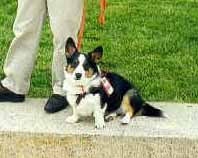
Belle is a Welsh Corgi pictured at top of page. Belle is a hearing
service dog. For more pictures of service dogs and service animals
and for more info about the marvelous work they do, please visit:
http://www.windchyme.com/Pages/ServiceDog/Servicepics/servicepics.htm


See Also:

All Canine Care & Doggie Fun Stuff

Search Our Site for Dog & Pet Information

How to Keep Your Dog & Cat Healthy


Really Neat Gifts & Gift Ideas for Dog & Pet Lovers

Unique Dog Breed Specific Gift Items

     Adorable Stuffed Dogs & Stuffed Animals

     Quality Dog & Pet Supplies

     Dog Calendars, Posters, Shirts & Jewelry


"Mellow Out" Natural, Dog Stress Relaxer

Natural Dog & Cat Food & Treats


Free ==> Tippy & Alfred's Fun Pet Newsletter

Site Map

Disclaimer


Page Design by: Tippy & Alfred
Copyright ©
Choose To Prosper